Thursday, May 26, 2011

The Emerald Sea, Madagascar

To see our Madagascar Photos, Click Here

A pirogue in the Emerald Sea
To save 3 days in a taxi brousse, we bucked up and bought a flight to the North - specifically Diego Suarez.  There are more parks we wanted to visit there, and our flight was out of Nosy Be - an island in the North.  It was worth the money, to get a few extra days enjoying.
We quickly found out that we would have difficulty getting to the parks without the aid (and $$$$) of a 4x4, so we decided to chill out for a couple of days at the beach in Ramena. 
Our accommodation was a little shoddy, but right on the beach in the sleepy little town.  The locals very friendly, except for one shop owner that tried to overcharge us for a beer, even though it was clearly marked.  When we questioned it, she got all defensive and ended up smashing the bottle on the ground, much to the chagrin of her staff, and people on the street!  Weird!!
We brushed off that little experience easily, as we immediately found our favourite little restaurant, right on the beach, serving up delicious calamari for cheap, cheap, cheap!!  MMmmmmmm, delicious - we did return.
Martin with the Friendly Kids on Ramena
We met some really cute kids earlier in the day, ones that just wanted to be picked up and swung around.  Turned out, one of the little guys was named Kidico, and he was the restaurant owner's son.  He hung out with us for dinners, and we had some fun babysitting him.
It was nice to chill for a little bit, and a nice beach at that.  The second day in town, we booked on a boat trip to the Emerald Sea.  After some confusion in the morning, and the "Africa Time" (1.5 hrs late), we hopped on the pirogue, and set sail with a couple of French guys out for some kiteboarding.  We thought it was a snorkel trip, but these guys were getting dropped off on a little beach and kiting over to meet the pirogue for lunch on this beautiful island in the middle of the emerald coloured water.  I was quite envious, but maybe I will return with my kite next time!!
The sailing was enjoyable though, as the scenery was spectacular.  We did manage to snorkel a little, but only whilst the captain was out snorkeling with a spear gun to catch us lunch!  And what delicious lunch it was - crab and fresh fish, with salads, chips and fruit.  Wow....   only a couple of cold beers topped that meal off just right! 
Lunch on the Island paradise
The guys managed another kiting session, whilst Michelle and I relaxed while watching crabs dig their holes in the beach in the powder white sand.  Then it was some sailing back home along the coast, into the bay.  We both had a good sunburn to remember the day!   *Stub

Sunday, May 22, 2011

Lemur Watching in Parc Nacional Ranomafana, Madagascar

To see our Madagascar Photos, Click here

With Joanne and John at Rianala Gite
We met John and Joanne on the train the previous day, and were planning to take a taxi brousse to Ranomafana.  As John's knee was acting up, Michelle and I walked to the taxi-brousse station, and John/Joanne were to follow in a pousse pousse (Vietnam-style foot rickshaw).  To our surprise, they pulled up in a nice big 4x4, that was apparently returning to Fianarantsoa, and was picking up a few fares as extra cash.  It cost the same as the taxi brousse, and was much more comfortable, and quicker.   Good score!!
South of Antananarivo is Parc Nacional de Ranomafana with lush hills and rainforest.  We stayed in a dorm-style "gite" with Joanne and John right outside the park gates - couldn't have been closer!!
Golden Bamboo Lemur
We had a couple of days in the park with a guide (Lorei) watching the golden bamboo lemurs up close and personal. Martin, in spite of feeling yuk with a head-cold was glad that he came out. It was special being that close seeing them preen and groom each other. We also managed another night walk, and Martin was excited because he finally spotted a chameleon on his own - not such an easy task.  We also were relatively close to a tiny little mouse lemur, about the size of a small rodent with long tail.

Onto Ambositra by taxi-brousse which turned out to be our worst one yet - the driver was going just too, fast racing another taxi-brousse about 3 feet  off his bumper (no lie!). After which we got off and kissed the ground. What does our heads in, is that there's absolutely no benefit that we could see - not even in picking up more fares! He was just plain crazy. I was so angry and scared I told him in a mixture of Malagasy and French that he had bad, dangerous driving. Ritza be! (very bad).  Martin just wanted to stay put, as he was in rough shape.  Too bad, as Ambositra is supposed to be the artisan capital of Madagascar, with some beautiful villages to the south that are Unesco Heritage sites, because of the indigenous people that live there.  Oh well, a rest day is required every now and then!!

Sunrise in Ambositra
To make up for this nightmare journey our next Taxi-brousse to Tana to catch a flight up north, was calm and pleasant - which was just as well as Martin was still nursing his cold, although feeling much better. * Mush

Friday, May 20, 2011

The Only Operational Passenger Train in Madagascar

To see our Madagascar Photos, Click Here

Train crossing one of the many bridges
We had heard horror stories about the taxi brousse from Morondava to Antsirabe.  First, it is a small mini-van packed to the gills, and takes about 12 hours or so to drive the pothole filled road.  Add to this, that at night, they try to group together in convoy, with a couple of policemen, to try to avoid the bandits - you can imagine that we were not really looking forward to the drive.  We had to get back though, so this was the only answer.  In reality, we found a vehicle going in the daytime, sat next to a local guide who complained bitterly when they tried to overfill the seats leaving us space, and only were on the road for about 10 hours.  Quite a pleasant journey actually, to our surprise.
Michelle's saviour - camera chasing man
Not so the next day, as we waited 4 hours for the van to fill, and finally we were off to Fianarantsoa to catch the only operational passenger train in Madagascar, from Fian to Manakara on the East coast.
The train is still used by many local villagers, heading to and from the markets and towns.  It seemed that the "First Class" car was filled with Faza's (Malagasy for foreigner), which was a little disappointing.  The train was going to stop often at local stations though, so we could move around.
Michelle became well known on the train within the first hour, but more for the fact that while looking out the open door, her camera case fell off the strap, and out the door onto the tracks.  A couple of the local train personnel saw this happen, and to our surprise they actually STOPPED the train.  Of course, the train took a little time to slow down, but one guy actually jumped out of the train, hopped on a bike of a local passerby, and rode back to look.  We had written off the chance of finding the camera, but back he came, with the case held high.  Michelle could have kissed him - her saviour!!!  So everyone knew Michelle now, including the train conductor, that came back to issue the "fine" for stopping the train.  We were expecting some exorbitant number, but he said it was 900 Ariary per minute - the equivalent of $0.45 per minute, and for 12 minutes, it would cost us about $5 - Phew!!!  That was worth it for the camera, and the camera finder guy also got a nice tip for his efforts which he was thrilled about!!!
Riding in "Second" Class
So, the rest of the journey was much less crazy!  The train traveled through some lovely hilly, rainforesty scenery.  It stopped VERY often at all the little villages to drop off locals, and produce, but also to allow the locals to board and sell snacks and food.  It was a day full of eating little snacks all along the way.  Some of us "fazas" would get off every station and meet the locals, but I felt a bit like we were staring into a goldfish bowl.  Of course, the kids loved getting their photo taken, and were really excited.  Then we were back on the move again, to the next batch of kids.
Michelle and I changed things up a bit, and spent some time in the "Second Class" car.  We got right in, and started talking with the locals and had a wonderful time there.  Everyone was very curious as to why we were there, and not in First Class, but they had beaming smiles, and friendly giggles.  We actually got invited to the home of Anna, who lives about half way along the journey.  It was with great regret that we had to decline, only because we had no idea where we would be, and we had a flight in a few days that we had to get to.  So nice though, and we love that part of traveling.
The gathering for the arrival of the daily train
As the afternoon was coming to a close, and dusk was upon us, we moved back to our car.  I particularly enjoyed sitting at the train door steps, watching the scenery rush by.  The journey was becoming a little long now, and most of us just wanted it to be over, and were relieved when after about 12 hours, we arrived in Manakara.  We celebrated with a beer at the hotel!   *Stub


Another fun stop in a local village

Sunday, May 15, 2011

Avenue of the Baobabs, near Morondava, Madagascar

To see our Madagascar Photos, Click Here
A 1500 year old Baobab

Years ago, I saw a photo in the Lonely Planet calendar of the Avenue of the Baobabs, and had always been curious to see these bizarre trees.  It was what really sparked my interest to come to Madagascar, and it didn't disappoint.
There is a small number of species of baobab trees in Madagascar (I believe 6 of 8 of the world's total), but all share the same thick round trunk, with spindly branches look.  Since we got back on dry land after the river trip, we had seen quite a few different varieties, and it was quite exciting to see them dotted along the horizon as we drove towards Morondava.  Apparently, they are one of the slowest growing trees, with 10 to 20 year old trees still only as high as your knees.
Along the way, we passed by villages based around some of these old trees including one little place with 4 exceptionally old trees.  They believe that these trees are between 1500 and 2000 years old, with the oldest and largest being very sacred to the people of the village.  You can see from the photo to the right, just the immense size of the trunks, as 6 of us are pictured at it's base.

Beautiful baobab trees
We met many kids along the rough 4x4 drive, and had some fun experiences including dancing to the music from our vehicle with kids copying in the distance.  Through the bizarre landscape, there was also a huge baobab, that had two trunks intertwined, which they called the tree in love.
But then we reached the highlight of our journey for me, the Avenue.  Not very long in length - possibly only a few hundred metres - the trees were very thick and quite dense along the road compared to other areas, so to speak.  I found it quite an enchanting place, and very surreal.  They are such a bizarre looking tree, and to see so many in one place really does look out of this world. 
The Avenue with traffic
We managed to stay for a few hours, watching the sky change from day, to sunset, to dusk with a colourful warm afterglow, then to eventually night.  I couldn't get enough of seeing these beasts.  It was so picturesque, and I couldn't stop taking photos.  It also seemed like you couldn't take a bad photo, as the trees were so photogenic. Although there were some other tourists there for sunset, it seemed peaceful and tranquil.  All except for a few of the locals calling out "Fa-za" which means tourist in Malagasy, then trying to sell you something.
Since this was  highlight, we decided to return again, this time for sunrise.  There were even fewer people here, and it was nice to see the area come to life for the day.  The locals washing in the nearby water holes, the zebu carts getting geared up for the days work, and the trees getting set for yet another day of curious tourists like myself.  *Stub
The Avenue of the Baobabs


Avenue of the Baobabs at sunset

Saturday, May 14, 2011

3 Days on the River Tsiribihina, Madagascar


Professor Martin at school near Antsirabe
Apparently, one of the classic trips in Madagascar is to float down the Tsiribihina River in a dugout canoe called a pirogue, with a couple of pirogeurs paddling you along.  Why be left out of the fun, so we signed up with the Australian's Clyde, Avril and Kerrie.  On the way to the river we were supposed to visit a couple of volcanic lakes, which were nice in their own respect, but the real highlight was when I asked our guide, Willy, to stop at the school that we passed.  The children were all lined up at the edge of the grounds and as we approached the school with our cameras, the kids went crazy, and the teachers seemed almost as excited to get some photos of themselves.  We were invited into the classrooms, and as soon as we showed them photos, the place erupted. 
Michelle with the kids at School
We thought we had really disrupted the lessons, but the teachers didn't seem to mind and kept on inviting us in to a new class room.  I went to the front of the class, and pretended to teach a lesson.  This had everyone a little confused, but they loved it.

The other Pirogue, with zebu on shore
Packing up the pirogues the next morning was quite an occasion - it seemed like the whole village came out to 'help' and see us off. Once on the river we left the mayhem behind and it was relaxing and peaceful. For the next two days we paddled down the river.  Our 'pirogeurs' Copan, Rene, and Mahatre (Tim) (we called him Tim because of the hockey jersey he sported - a Tim Horton's Timbits shirt - all Canadians will know what I'm talking about) were great - nothing was too much trouble and they were always laughing and giggling and having fun like little children. The food they cooked was absolutely delicious - some of the best we've had in Madagascar. As we discovered, always in Madagascar, meals consist of rice (Madagascans consume 125kg of rice/per head/year!). So we would have rice and fresh salad and either freshly caught fish, Zebu (their local beef) or even fresh chickens that say at the clucking away at the back of the pirosue that were slaughtered and plucked just before dinner.

Campsite for night #1 on the River
We floated alongside river banks and saw lots of birds and chameleons. The sun was scorching hot. At lunch times we would stop at a village or a waterfall. We were hoping for more activity on the water but right now it's cool season so there wasn't as much activity with people cooling off. Unfortunately, as with most of Madagascar, the rain forests here have all been cleared for agriculture and the terrain was grassy and bare. As a result the water is very brown and sandy from erosion. We camped every night on sand/mud bank of sorts for great sunsets and sunrises. To finish off the river trip, or more, to finish us off!, we took a very bumpy and tippy Zebu cart to the village where were staying at. Our 'hotel' was extremely authentic - limited electricity and pot showers. I don't think Kerrie was all that impressed. Martin and I on the other hand loved its authenticity and the local village.  *Mush/Stub


Tuesday, May 10, 2011

Real Animals, Not Just Cartoons in Madagascar

To see our Madagascar Photos, Click Here

Martin with the Kids in Andasibe
We are loving Madagascar.  The people here are fantastic, so warm and friendly.  Genuinely happy to see you, with huge smiles and puzzled curiosity.  Such a refreshing change from Morocco, where everyone seems to have a motive to sell you something and you always have your guard up.  Or South Africa, where we are warned that everywhere is dangerous, and be careful.
This is the way we like to travel, with lots of interaction with the locals.  Often people ask for their photos to be taken, but not for money, just the excitement of seeing themselves on the screen.   And excited would be an understatement, as the kids go crazy when they see the pictures!!  We've had entire villages of kids jumping around and dancing with us - what fun!  The people seem to be a mix of both African and SE Asian descent, and many of the faces are truly beautiful.
And that is just the start.  The scenery here in Madagascar is at times, breathtaking.  Granted that probably 80-90% of the rain forest and dry forest has been logged and destroyed.  An absolute tragedy for both the land and wildlife, but the countryside, and villages still have a beauty, and lushness to them that inspires awe.   From terraced rice paddies, to mud brick houses, to rolling hillsides, and rivers and waterfalls aplenty.
We started our journey in picturesque Antananarivo (every person and town have extremely long names), and met up with a trio of wildlife junkies from Australia who had rented a driver and car for their trip,  We decided to join them for the first portion and were taken around by Hasina (short for Rasolofonjatovo Fenohasina).  What a fabulous man, who had a smile to light up the room, and a very contagious laugh/giggle.  We had some great laughs with the whole group.
Michelle with some Brown Lemurs that were not SHY
The journey took us to Andasibe/Mantadia, which is home to 2 National Parks or reserves.  We stayed at some lovely huts skirting the parks, and had guided walks both day and night to find some of Madagascar's wildlife.  Wildlife that is only found on the worlds 4th largest island!!  And surprisingly, we managed to spot many a strange creature.  There are 70+ types of lemur here, and we found all different types from the wailing Indri (that looks like a child dressed in a panda suit), to the tiny mouse lemur, and the colourful white and beige sifaka.  And plenty of wild chameleons around, although obviously, they are hard to spot.  So many different colours, and we even fed them crickets, to see their enormously long tongues the length of their body and tail combined, shoot out and retrieve the bug.   Odd shaped giraffe weavels, that really look like miniature giraffes.  And a lucky spotting of the rare comet moth, just resting for the day.  The most beautiful moth I have ever seen with yellow and orange colour, and two sweeping long tails!!  This is to name just a few.
To finish, we spent some time at a reserve, where they are trying to introduce some injured lemurs back to the wild.  We were so close, we were able to feed sifakas, and bamboo lemurs, with their gentle paws/hands reaching out to hold ours, and gently taking the banana.  The brown lemurs were less shy, jumping on our shoulders and scurrying around, licking our sweat stained clothing!!  Fantastic!!
Home made land luge
One of my strange highlights of our journey was watching a family of 6, ride down a long hill on what I can only describe as a homemade, makeshift, rickety land luge.  They must haul stuff up hill on this cart, and then use gravity to get themselves and other things home.  I would have loved a ride on one of these!   *Stub


Sunday, May 01, 2011

5 out of 5 - Kruger Park, South Africa

To see our South Africa Safari Photos, Click Here

3 sizes of elephants crossing
Once we figured out that we were going to fly out to to Madagascar next week, we needed something to do for 6 days.  We had a good night at the hostel bar, meeting some new friends and woke up the next morning to figure it out.  Our first task was to find a rental car - usually easy, but this was Freedom Day in SA.  Next, we searched for camping in Kruger Park and were able to book the VERY last sites for 3 nights over the Easter weekend.  They were at different sites, but we thought this was fine, although not knowing the distance between.  Now we needed a tent and a few camping supplies - hopefully a shop is open to buy some cheap stuff.
On our rushed way out to get the car, we spoke to new friends Fia and Christo briefly to say goodbye.  A long story short, they live up on the outskirts of Kruger Park, and invited us to stay the night.  Not only that, they offered up all their camping supplies for us to borrow for the 4 nights there.  WOW!!  So in a few short hours after waking up, we were on our way to Kruger with an overnight stop in Hoedspruit - the air base there, as Christo is a helicopter pilot there. 
In Kruger you drive yourself around the park wherever you want. You are not allowed to get out of your vehicle (for good reason) and have to be in your camp by gate closing time.  To say that luck was on our side in these days would be an understatement.
In search of the Big 5 animals, we managed to see them all!!!  I guess you should consider yourself lucky to see all, and we did.
African Buffalo - a huge herd or about 400 rumbled across in front of our car including young
Elephants - about 30 or so were watering themselves off, then passed in front of the car, including some babies
Rhinos - we spotted 11 rhinos, including one baby and a group of 4 about 20 feet from the car
Lions - 2 huge male lions lying in the road, and a group of 8 sunning themselves on some rocks, along with another female on the road
Leopard - our last one and most elusive - who would think we would see this nocturnal animal on the dirt road ahead, and cross just 100 feet in front of us on our very last day!!
Two huge male lions on the road in Kruger
We also spotted some wonderful other sights including baby giraffes, a hyena feeding her young just 10 feet off the road, 3 cheetah in the distance, yawning hippos, baby zebra, hornbill birds jumping onto our window sill,  the huge strides of a running giraffe, families of warthogs, the stereotypical watering hole scene with loads of animals, ostrich, horny baboons, blazing sunsets, elephants freaking out and charging across the road, and tons of other wildlife.
The camping was great, and the noises in the park were fabulous.  We managed well with all the camping gear and owe a massive thanks to Fia and Christo for helping us out.  You meet some great people traveling, and some will give you the shirt off their back after only a brief encounter.  We hope to one day reciprocate, because without them our trip would have been much more difficult.  We even managed to spend another night with them on our way back to Jo-Burg.  We had a lot of luck on our side this trip, and can't believe it came together so fabulously from no real planning.  What a great adventure!!  *Stub

A leopard crossing in front - the last of the Big 5

Sunday, April 24, 2011

So-Where-To or South Western Township or Soweto, South Africa

-To see our South Africa Photos, Click Here

Fanu's House in Soweto Slum
To avoid the raining season soon starting in West Africa we decided to head south to South Africa.
Johannesburg was a culture shock coming in from Morocco - it's very suburb oriented and we found it hard to know where to stay. Staying in a hostel in the mid-northern suburbs we found it expensive to get around easily. Our trip to Soweto was definitely interesting, and our local Soweto guide, Mandy, was informative and a lot of fun. Four million people live in the black township south west of the central Johannesburg. This is the most famous township, and many blacks were moved to this location by the Apartheid regime. 
It seemed a very developed suburb with full services and facilities (the hospital was massive and gives birth to 120+ babies a day!) and we noticed a wide range of affluence. Everything from large homes to tin shacks. We noticed there was little security as opposed to other suburbs in Jo'burg - like barb wire and razor wire fencing. It felt safe in Soweto and we visited a local tin shack community. A young teenager, Fanu, guided us around his home and 'village'. He was very proud of his room in the tin shack that he shared with his sister. It had all that you really needed and was spotless.  It was Easter Sunday and we met kids and adults hanging
Super Cute little girl posing in Soweto
out or doing their Sunday chores. There were lines of washing everywhere. We played and danced with the kids as the followed us along the mud paths in-between their homes. The people were friendly and you could tell that they took pride in their small, yet clean and tidy homes. The well where they collect their water was sadly filthy around.
We visited the Hector Peiterson museum learning about the black student uprising against the abrupt introduction of the Afrikaans language in schools in 1976.  Hector Peterson was just one of many teenagers in the peaceful protest that were horrendously massacred by police. In all, over 1000 students died over the next while protesting this.
According to Mandy, Nelson Mandela's house had been modernized out of recognition, since he lived there.  We passed by Bishop Desmond Tutu's house also which was a block away.  Two Nobel Peace Prize winners' homes on the same block - pretty impressive. We felt safe and we visited a local market trying local snacks, and then onto Mandy's friend's new bakery / restaurant. It was an interesting, and eye opening morning!

Kids lined up in Soweto

We felt safe in Soweto, but were unsure what to make of the rest of Johannesburg. We walked around our suburb which seemed entirely black and felt ok. It seems though that the white people keep themselves to themselves and live in their homes secure as a fortress, venturing out only in their cars.  We did tour around the Hillbrow district in Joburg with Mandy - not a place I would want to venture out on my own.

Unsure about how we felt, we moved on to the capital of Pretoria. After searching for 2 hostels that now no longer exist, we came upon 1322 Backpackers.  This place was great, and we really enjoyed our time here getting plenty of info for the rest of our trip.  It was such a treat to feel more comfortable about South Africa, which we knew we would find, but it took time coming.
In Pretoria, we visited the Voortrekker Monument in tribute of the Dutch Afrikaans people who traveled into South Africa's interior to get away from the British ruled towns on the coast. Interesting and with great views over the city of Pretoria. We always like to catch local transport wherever we go so getting around was different and we got stared at quite a lot. We walked around town exploring the centre, again noticing that not many white people were out and about even though it was Easter Monday. The beautiful Government Buildings were more touristed and there was a lot of activity for South Africa's major holiday coming up - Freedom Day. * Mush

Thursday, April 21, 2011

Here's Lookin' at You......Kid - Casablanca, Morocco

To see more Morocco Photos, Click Here

Hassan II Mosque
Casablanca is a huge modern city of 3.8 million people on the Atlantic coast of Morocco.  A very cosmopolitan city where you see old traditions, and very new styles, offering a unique insight into modern Morocco.  Being a big city, we had decided to only spend one night there before flying out of Morocco, but we did enjoy our brief time there.  
The main attraction in town is actually very new.  Built in the '90's, the Hassan II Mosque is the world's third largest mosque.  It is very impressive, with the attention to detail exquisite.  Unfortunately, there are some negatives in particular the half billion US dollar price tag, which many argue could have been used much more effectively elsewhere.  Helping feed the poverty stricken, homes for the homeless, - you see where I am going with this.  We even heard that they kicked out the slum dwellers that were living on the site, and gave them no compensation. 
That being another issue altogether, visiting the mosque was a treat.  It is one of the few mosques that non-muslims are allowed to enter with a guided tour, although we missed our opportunity.  The mosque is situated on a rocky outcrop, reclaimed from the sea.  It can hold 25000 worshippers, and another 80000 in the courtyards surrounding it.  We were told that it actually has a retractable roof, and a glass floor over the ocean. We have also heard that a futuristic laser beam points from the tower towards Mecca in the evening.

Muslim photographer at Hassan II Mosque
It was constructed by the present king's father, Hassan II in honour of his 60th birthday, and I suppose he was one for detail.  All the intricate mosaic and tile work was immaculate, and the massive doors were detailed and impressive.  It seemed like many locals would hang out and enjoy the surroundings, while others were more touristy, taking photos around the place like the couple pictured here.
A walk through the old medina was busy with the bustle of people selling and eating.  It had a different feel from other medinas, but still a nice vibe.  We ate at rotisserie street, an area of cheap eateries, with tons of rotisserie chicken on offer.
We left our youth hostel in the morning after sleeping in his and her dorms - strange for us.  Michelle had met an Algerian lady named Mina, who kindly gave her a gift of a CD of Moroccan music - how nice was that!!
On to our next leg of the journey.  Since Western Africa is approaching a rainy season, and flights were actually cheaper to head South, we were off to Johannesburg, South Africa with a brief stopover in Cairo, Egypt.  From desert to safaris - exciting!!   *Stub

Tuesday, April 19, 2011

Under the Shadow of North Africa's Tallest Mountain, Imlil, Atlas Mountains, Morocco

To see more Morocco Photos, Click Here

Town of M'Zzick in the Atlas Mountains
Imlil is a cute little town at the foot of Mt Toukbal (Jebel Toubkal) - Northern Africa's highest mountain at 4167m. The town is situated at approx. 1700m, and is a base for climbing the mountain.  When we'd first arrived in Morocco in early March it was a little too soon to do the two-day climb up Toubkal. Unfortunately, we were so busy, that we didn't think to reconsider doing it as we drew nearer to the end of April when conditions are more favourable.
Getting there was an adventure in itself.  Most people said it wasn't possible or it would take ages, and most tourists get there on a pre-arranged tour, but we wanted to try and do it cheaply by public transport - a local bus and a couple of collective / public Grand Taxis. Of course, it was possible and it cost a fraction of the price of a day tour (though it took about twice the time to get there - about 3 hours - which was fine with us).
Martin below Jebel Toubkal, and town of Armed
It was definitely worth the overnight trip up into the hills as it was super scenic and we ended up staying in a Berber village in the Toubkal's foothills. Many of the locals had set up 'gites' or guesthouses, as the climb has become quite popular.  We walked from village to village exploring the area and it gave us inspiration to come back and climb Toubkal in the future. We talked to a few people who were on their way up the mountain, or some that were doing a long trek throughout the Atlas Mountains.  We were a little surprised at ourselves for not allowing time for this area of Morocco, because we love the mountains, and things were in bloom.  But, just being in the mountains was quite a shock to the system after coming in from the Sahara just 2 days prior.

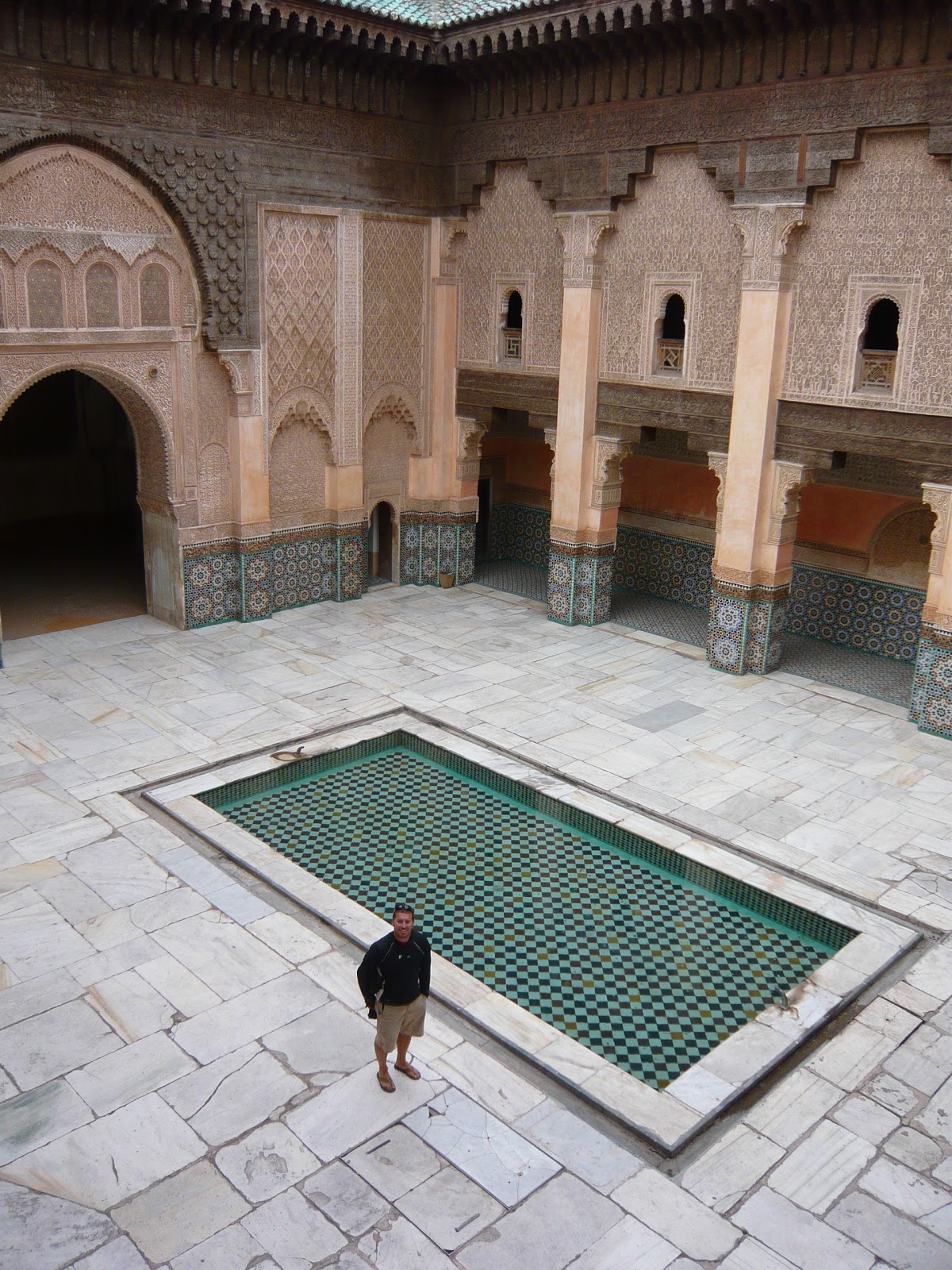
Martin in the Medersa
Heading back to Marrakesh was super easy and even quicker than our journey the day before, as we
were old hands at it now. Once back in town we made the most of one more free morning before leaving the country by heading to a couple of historic sites that we hadn't visited before: The Musee de Marrakesh was a beautiful 19th century building with some great restored architecture and some interesting exhibitions. It was purchased by Omar Benjelloun and restored beautifully.  The Koubba Ba'adiyn was a crumbling ruin with great character - it was used previously as a bath house and latrine. My favourite, though, was the Ali Ben Youssef Medersa, or theological college, that had recently been restored with some amazing architecture. Early morning there with hardly any tourists and we almost had the place to ourselves and could explore the little study rooms in peace - not found much in Marrakesh.   The details of the decoration of this building was amazing, but we were driven out when the hoards of bus tours started coming through the door!   *Mush

Monday, April 18, 2011

Hollywood in the Desert, Ouarzazate, Morocco

To See More Morocco Photos, Click Here

Michelle on the set for Kundun at Atlas Studios

After our lovely, calm trip to the desert, we hopped on a hair-raising minibus ride to Zagora.  This guy pushed the limits of the one lane road, and really played some game of chicken with the oncoming traffic.  Scary enough, that at one stop, we moved back in the bus so as not to see it coming!!!
Zagora, was unfortunately tainted a little, as we had major trouble finding our campsite.  It was a very cool little spot, but because we arrived so late, we couldn't' enjoy it to its' fullest, and we left very early in the morning, heading for Ouarzazate.
The main site in Ouarzazate is the Kasbah, an old mud-brick fort that has been partially restored. For centuries, this was the place where people from the Atlas Mountains, Draa Valley, and Dades Valley converged to do business. Hollywood found Ouarzazate back in the 1950s and has used the kasbah and surrounding scenery as the backdrops for films including "Lawrence of Arabia", “Gladiator", “Jewel of the Nile", “Kundun", to name a few.  There is also a private studio called Atlas Studios, which we took
Martin with kids in Ouarzazate
a guided tour of.  The sets were all made of lightweight material, and even styrofoam.  From the back, all the walls were just propped up with wooden scaffolding, and some haven't stood up to the test of time.  We were on the sets for Gladiator, Asterix (Cleopatra film), and Kundun.  There was a full set of Jerusalem built out in the middle of nowhere behind the studios.  A really strange sight.
The people were quite friendly here in Ouarzazate.  We had some fun moments with the kids living near the studios, and then taking a bus all the way through town we chatted with many locals on our walk back to our hotel via the Kasbah. 
To celebrate our quick day in Ouarzazate, we had our first beer of/in Morocco.  A delicious Stork brand, which we enjoyed on our rooftop terrace, overlooking main street and our great little Patisserie across the street.  *Stub

Saturday, April 16, 2011

Sandstorm in M'Hamid, Morocco

To See our Morocco Sahara photos, Click Here
Our guides and trusty camel companions in the desert

Since the trip to the dunes in Merzouga was a little disappointing with all the 4x4 tracks, we decided that we wanted to get out into the desert a little farther, and avoid the "vehicles and tourists".  At the end of the road literally, we arrived in M'Hamid.  One of the webpages described this area as "somewhere of nowhere", and it certainly was.  We decided to book locally and support the people of this little town, and managed to easily get ourselves on a 5 day camel trek out to the Erg El-Zahar dunes (Screaming Dune as it's called when the wind blows) and back.

We picked up supplies which included 10-5 litre jugs of water, and a bunch of oranges for some sweetness and flavour.  We set off early the next morning to take advantage of the cooler temperatures earlier in the day.  Our guides were Mustafa and Zaid, and we were told we needed two guides in case
Another curious camel between Zaid and Omar
one of them dies along the way, the other can get us home.  I guess that hit home a little, as I suppose we are heading out into dangerous mother nature, and anything can happen.  One was a camel man, and the other a cook, but it seemed like Mustafa did most of the work making all the food and leading the camels, and Zaid just laid around, while building and tending the fires whilst making tea!  He would get out this massive block of sugar and chop off a chunk to throw in the tea.  I came to really look forward to my sweet tea at the stops!!  Zaid also made this fantastic bread in the sand on our final night.  The bread we had brought was getting pretty stale by this time, so he made the dough, dug a hole, put in some coals with the dough on top, and covered it with coals and sand.  And voila...... a short while later we were eating delicious fresh bread cooked right in the sand!!!
They did both have a good sense of humour though, and we had some good laughs even with the language barrier.  I do think that Mustafa was a little sweet on Michelle, and who knows.... I might have been able to earn some camels for her!!  Just kidding, I kind of like having her around!!!
We found out early on that, a five day camel trek into the Sahara dunes does not actually mean you ride the camels.  To our somewhat surprise, they are there just to carry all the stuff, so we set out to walk in the desert for 5 days.  And we walked and walked and walked, probably about 20 km each day.  We would walk for 2-3 hours in the morning, then stop for lunch under some of the only shade around for about 5 hours, waiting for the sun to cool down slightly, the  we would set out for another 2-3 hours.  But boy, was the sand hot in the afternoon!!!!  I had my flip-flops on, and in the loose sand, it would cover your bare skin and it would BURN!!!  Sure toughened my feet up after 5 days of it!
Sandstorm in M'Hamid desert
Another bit of a surprise to us, was that we had no tent!!  We are unsure if the trip organizer "forgot" to give our guides a tent because he was actually dealing with a death in the family that day.  Or since we managed to reduce the price to 300 dirhams a day, maybe a tent was just not included in this price.  We never thought to ask, but here we were in the middle of the Sahara with no cover or protection from the wind.  Most of the time this wasn't an issue, but one night we had a big sandstorm, and laying in our sleeping bags, we got covered in sand!  All we could do was drape our sarongs over our faces and hope all our stuff was covered up well!!  Very rough night indeed, but luckily it stopped in the morning, but we didn't get much sleep.  We also had to deal with daytime sandstorms too, and these went on for hours.  Again, we had not protection from the wind and had to huddle behind our sleeping pads.  A bit uncomfortable, but the worst was getting sand in all our food that Mustafa had carefully prepared for us.  I ate a lot of sand in those 5 days!!
Curious camel at camp
Our other trusty companions were the two camels that carried all our gear (minus the tent), food and water.  Both named Lasfar which we found out to be the colour, they were very gentle, and just interesting to have wandering around camp.  Michelle really took to feeding them the food scraps, and they loved all our orange peels especially.  They were quite curious at times, stepping right in to our sitting area, or sniffing around to try to sneak some food.  At each stop, Zaid would attach the camel parking brake (tying their front legs together loosely), and they would wander off.  At first, we were a little concerned when we couldn't even see them near the camp, but Zaid always managed to track them down.  At night, he would put on the serious brake, in which he tied a strap around the knee, and possibly tied to the other leg also.  But they didn't seem to mind, and were there every morning!

All this talk, and yet none about the scenery.  In a word, it was surreal!  At first we were basically walking through scrubby desert, but there were small dunes around us.  With Algeria in the distance to the South, we continued to walk as the dunes got larger and larger, until we reached the Erg El-Zahar,
Martin climbing the Erg El-Zahar dune
which they call the Screaming Dune at 150m high or so. We set up a camp, and Mustafa and Zaid waved us off to explore the big dune before sundown.  As the sand was finally a little cooler, we managed to both climb up to the summit and have fabulous views over all the dunes as far as the eye could see.  Colours were quite amazing, sort of a gold-ish brown.  We met a few other tourists hiking to the top including a couple of French guys from the bus to M'Hamid.  As always, I love my downhill, so after some well earned time at the top, managed to run all the way down the big dune with the French friends taking a video.  Dig in the heels, and keep the momentum going!!  I think I could have stayed up at the top for days.
The remaining scenery was anything from dry river beds to rock desert that stretched for miles.  The rocks in the desert contained many fossils and shells from being under water at one point.  It was interesting looking for the fossils, but it sure dragged on for miles and miles and miles.  It was in the rock desert that we encountered a large cluster (not sure what the correct terminology is) of camels, including quite a few babies that were exceptionally cute, and hustled along beside the adults.  The camel-men, were the only locals we saw on the entire trip, except for this crazy old Berber guy, who appeared in the middle of nowhere and was yelling from the top of a sand dune.  He joined us for lunch, then a nap, then wandered off back into the dunes still smiling away!!!  We have no idea where he was going!!
Our bed for the night in M'Hamid desert
On our third afternoon, trudging our way through a big sandstorm, we arrived at our camp for the
night.  It was a fixed camp owned and we would have a roof over our head for the night.  We were the only guests staying that night, which meant we had time to spend with our guides and the 3 young guys who work at the camp full-time.  Omar, Jamal and Eunice were really nice guys, and it was great to hang out with them in a much more casual setting, rather than them serving us and catering to our needs like most tourists staying there.  Apparently, we were very good luck to them, because shortly after we arrived, the sandstorm was cleared by a rain storm.  Rain in the Sahara..... who would have thought.  It rained quite heavy for a short time too... and was very refreshing after being sandblasted for hours.  In the morning, we awoke to some bright lights, and quickly realized that it was lightning.  I hustled up the dunes to try to get some photos, and wouldn't you know it, the storm stopped just before I got to a good photo sight.  Disappointing, but still in my memory bank along with so many other great experiences on this journey!!!   *Stub

Friday, April 08, 2011

Chilling with Hendrix in Essaouira, Morocco

To See our Morocco Photos, Click Here

Essaouira from the Skala du Port
We were ready for a little chill-out time, and what better place than the beach town of Essaouira (pronounced Essa-wee-ra).  Steph and Jer continued on with us from Marrakesh (I guess they are not sick of us yet!), and we were greeted by madness at the Gare Routiere (bus station) in Essaouira.  Touts almost coming in the doors of the bus, which we hadn't seen the like of in Morocco yet.  We accepted one touts help, and he showed us to a very nice 2 bedroom apartment (with kitchen), which was very inexpensive, and the 4 of us moved in.  This  meant we could make some of our own food, and we also managed a large salad, as veggies have really been lacking in Morocco. 
Essaouira ramparts, Skala and port from our hotel
Tackling the local markets for all the items is, as always, quite fun.  We also managed to find a small, friendly liquor store and tried some of the local wines - the first alcohol I've had in over a month.  That's got to be the longest I've gone without any booze for 20 odd years!!
The town did have a great vibe to it, even walking down the main strip with our backpacks on.  Funky restaurants and cool chill out lounges, obviously spurred on by the increasing number of tourists to the town, but the people were exceptionally friendly and hospitable, while also being very relaxed.  Although, our apartment owner was a bit of a grumpy old guy, both on arrival and departure.  It sure would have been nice to visit this town before the influx of tourists, as I've heard it was excellent, but also a bit hippy.  Apparently, Jimi Hendrix spent some time here back in the 70's and the locals still say that the old ruins on the beach inspired his song "Castles Made of Sand".
Locals on the Ramparts for sunset
Essaouira is not all about tourism.  It still has a large, commercial port, and the closer you get, the more fishy the smells.  Not to mention the masses of hovering seagulls waiting for a free meal from the fish cleaners.  Just outside the gates of the port are a bunch of little food stands, with some colourful and delicious looking varieties of seafood available for BBQ-ing.  They seem to weigh it all up (including trays), then adapt a price for you with extra for bread, salad, drinks, etc.  It was kind of a weird experience, and I'm not sure the four of us came out of it with that great a feeling.  The guy just wasn't listening to what we wanted, and kept throwing on different fish and giving us a price.  We weren't trying to bargain, just get the seafood we wanted based on what we could afford.  I don't think he was entirely happy settling at our price, and neither were we.  Just hoping our food didn't get too much "Spit" on it!!  Too bad, as we were hoping for a good experience, and good food.  We ended up with a huge rock crab, baby calamari, a delicious red snapper, and a small tuna + salad and bread for $25 US.  Can't be too upset about that I suppose.

Jeremy and Steph in Triskala
It was with great sadness, we said goodbye to Steph and Jeremy after 2 nights.  The final night out with them was at a really cool little lounge called Triskala, set up like a cave with comfy cushions in different areas, listening to some live music.  In the morning, we were on our own again, so we moved out of the apartment, but found a super cheap place up against the sea wall ramparts, complete with old Portuguese cannons, and plenty of locals sitting on them while watching the sunset.  We had waterfront views for only $12 a night, and some great sunsets.
There were also some interesting fortifications near the port, so we climbed up the Skala du Port, and enjoyed the views over the port and towards the city.  This is where all the postcard photos are taken, as you get seagulls soaring and floating all around, in front of the main view of the city against the city walls.
Sunset from our Hotel Terrace
The rest of the time was spent on the beach when possible.  The winds here can be quite strong often, so good for kiteboarding, but makes you feel like you are getting sand-blasted when trying to relax on the beach.  Maybe this was foreshadowing for what was to come.  We could see ourselves coming back here and maybe spending a month or two, relaxing and working on my kiteboarding skills.   *Stub


Monday, April 04, 2011

Marvels and Mysteries of Marrakesh, Morocco

To see our Morocco Photos, Click Here

Steph, Jeremy and Michelle at Night Food Stalls - Djemaa el-Fna
Once the hub of camel caravans and traders from the south, over the centuries the oasis of Marrakesh developed into a big bustling city with a hint of the exotic. Now a Unesco Heritage Site, the main square, called Djemaa El- Fna or La Place, is the pulse of Marrakesh and is quite literally an overload to the senses - the sounds, the sights, the smells. Everything from smokey food stalls to fresh orange juice carts, from dancing monkeys to snake charmers; from dentists selling their skills by displaying their latest tooth extractions (eeew!) to herbalists selling miracle cures from the Sahara.
Djemaa el-Fna at night

At dusk this magical place transforms as row upon row of open air food stalls are assembled and cook up a storm filling the air with smoke and mouthwatering aromas. Locals and tourists feast on barbecued kebabs and seafood and tajines, snail soup, harira (chickpea soup) and even goats heads if you want. Walking through the stalls feels a bit like running the gauntlet as the chefs and touts try to entice (more like bully) you into their stall. We did choose a place and it was a fun experience to sit there and soak up the whole atmosphere. At sunset, the beat seemed to change and the hypnotic piercing oboe-like sounds of the flutes of the snake charmers were replaced by the beat of drummers and musicians. The square filled with crowds of locals as they clustered around storytellers, fortune tellers and magicians.

La Place is in the heart of the medina or old town, and we found a cute hotel with character not far from the square (for $13 with wifi). After our desert trip we spent a couple of days exploring the medina's souqs - a warren of narrow lanes choc-filled with shop after shop of touristy souvenir schtuff.

Steph, Jeremy and Michelle at the Koutoubia Mosque
The ancient sites of Marrakesh were interesting: The Bahia Palace built in 1580s is basically a huge open square surrounded by red mud/straw walls with the usual stork colony in huge topsy-turvy nests teetering on the highest ramparts. Other features were the sunken orange groves, underground dungeons for storage - food and prisoners alike - and also a 12th century minbar or mini-bar as we called it: basically a beautiful restored wooden pulpit from the Koutoubia (main mosque) - the oldest wooden relic remaining. My other favourite site in Marrakesh was the Baadia Palace which, rather, than a series of crumbling ruins, was built recently in the 19th century for a prince/king with his four wives and 24 concubines! It had nice cool and shady courtyards and elaborate halls and rooms that were linked from one to another.

Rediscovered and restored by the French in 1917, the elegant mausoleum of the 16th century Saadian Tombs is the burial place of the Saadian princes, descendants of the prophet Mohammed.  These tombs were blocked off and hidden from raiding armies, and only discovered from the air, and then an entrance tunnel was constructed.  There are also 166 other tombs in the complex.
Martin at the Really Big Slipper Shop
The 70m tall Koutoubia Minaret built in 12th century is the oldest and best preserved of three famous minarets by Almohad Sultan Yakoub el-Mansour - the other two sister minarets are, in Morocco's capital city Rabat and, perhaps the other more impressive, Giralda in Sevilla, Spain. Beside the Koutoubia are the remains of a previous mosque that had to be torn down as it wasn't in alignment with Mecca!
The everyday life that continues as we wander around the sites - people selling their wares, sewing, making things, bargaining and persuading, and even begging etc add to the tangible excitement of Marrakesh. * Mush